Math
Using raw measurement data is often not enough. The DewesoftX Math module provides real-time or post-processing data analysis, allowing you to create custom channels, apply filters, and perform advanced signal processing, such as FFT, statistics, calculus… It supports formulas, C++ scripting, and specialized modules for diagnostics or hardware control, with automatic channel synchronization.
The Math module is added by default to all setups. When you open it for the first time, you will see the following:
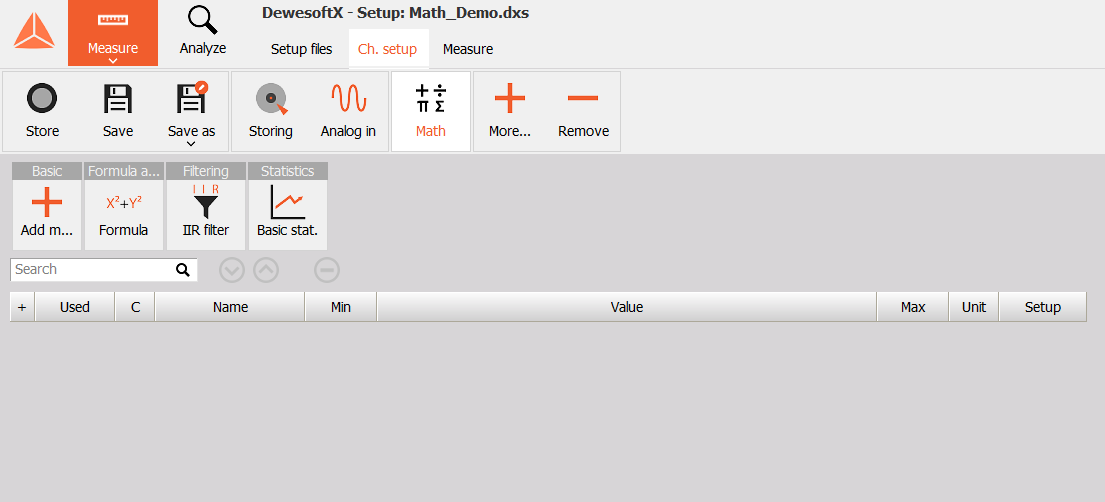
There are four default buttons in the toolbar:
- Add math
- Formula
- IIR filter
- Basic statistics
Use the Search bar to quickly find a certain math channel, change the order via the up and down buttons, and remove a selected channel by using the - button.
NOTE: Changing the displayed order will not change the order of calculations, which is set automatically by DewesoftX.
For extensive calculations, you can opt to use multiple CPUs and perform them in parallel. This is available only for multi-core processors. It will work best if the math modules are independent from each other, e.g. IIR filtering of several input channels. If the channels are referencing each other, this option will not be possible since calculations depend on one another.
Add Math
After clicking the Add math button, a menu will open. The default tab shown is the Favorites tab, which you can modify by switching to the Manage favorites tab.
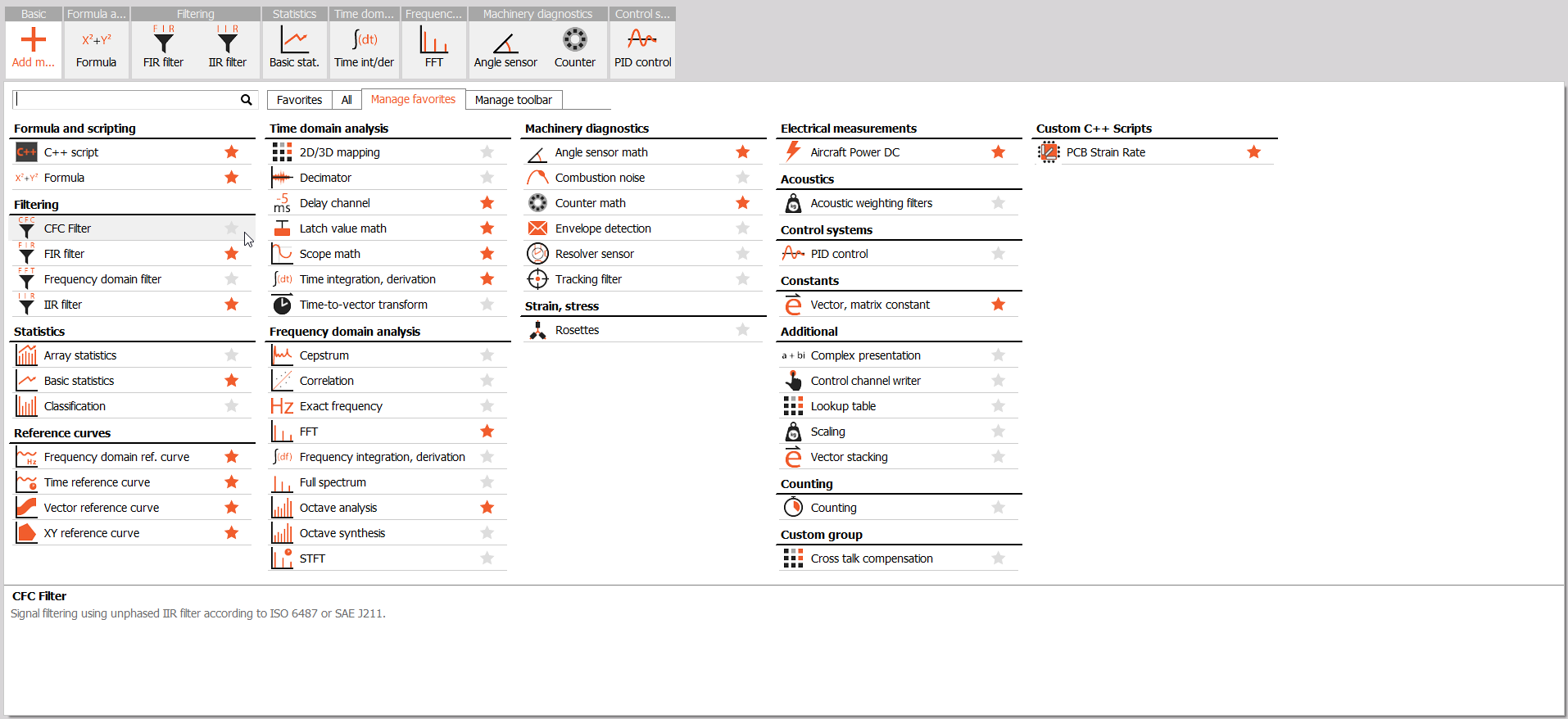
Switch to All to see all available functions.
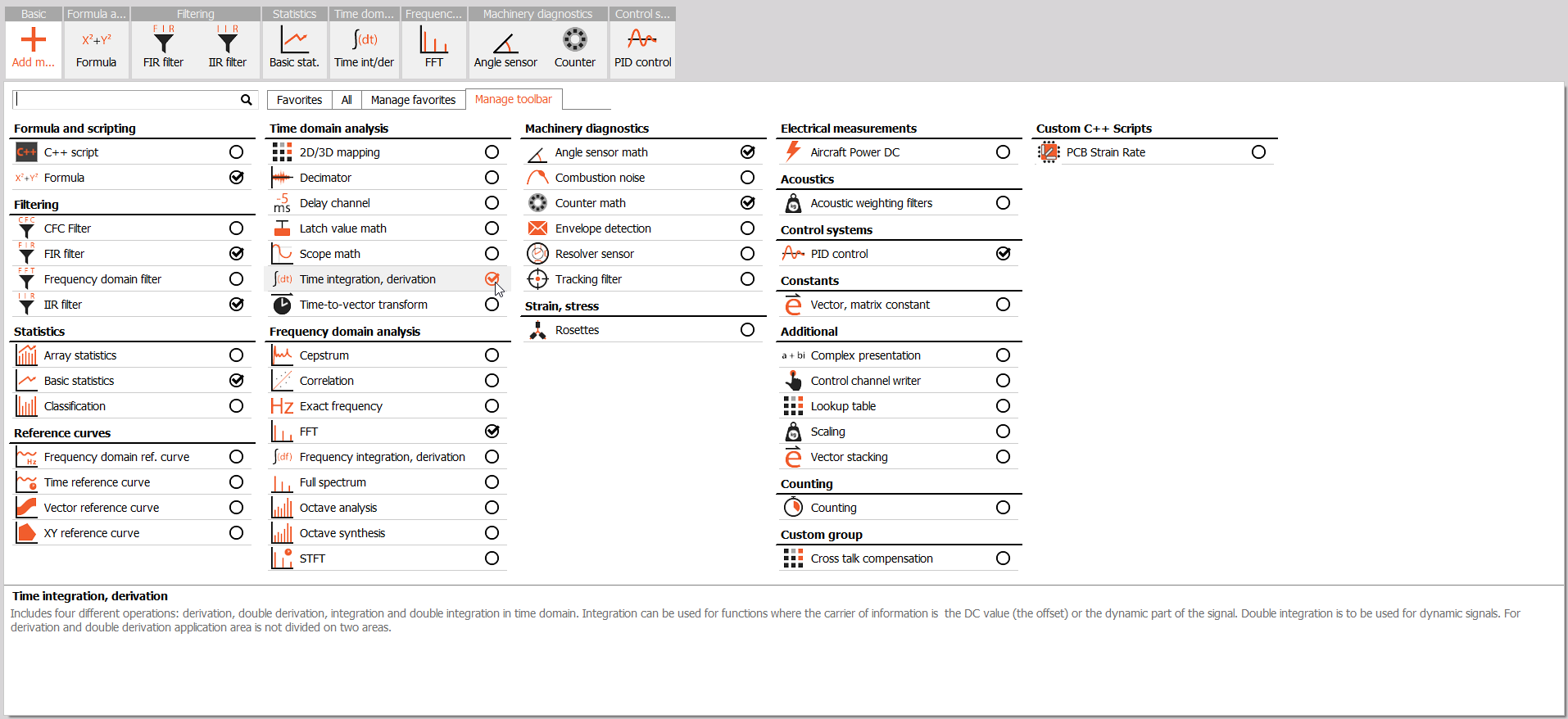
To modify the toolbar and add/remove buttons, go to the Manage toolbar tab.
Add Multiple
You can add multiple instances of a function by right clicking and selecting Add multiple. You can do this in the toolbar, Favorites, and All tab.
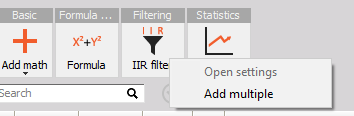
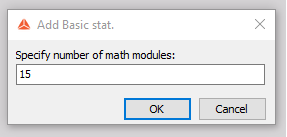
A menu will appear in which you will define the wanted number of math modules:
Available Functions
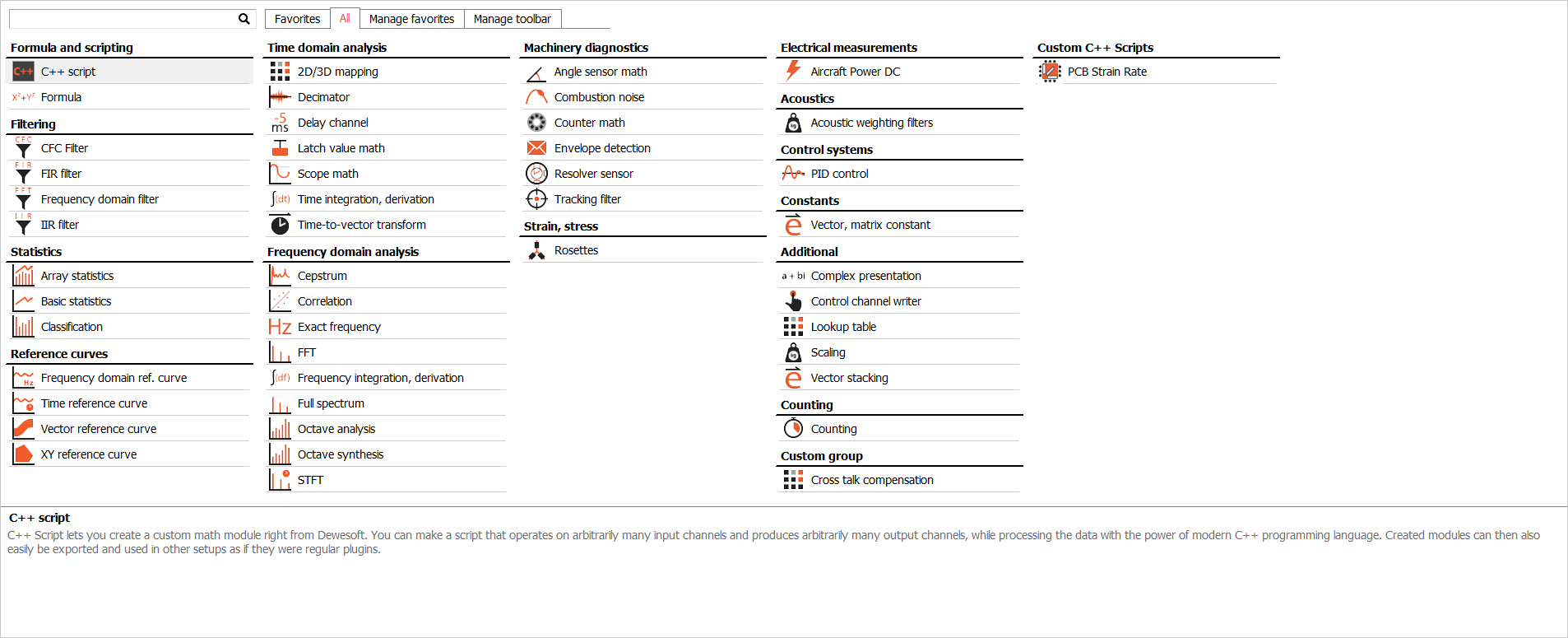
All available math functions and the categories they belong to are listed below. Click on any one of them to be taken to its dedicated page for more details.
Channel Grid
After you set a Math module up, a new Math channel will be added to the grid.

The columns in the Math channel grid are:
- Used - activate / deactivate the channels
- C - channel color selector
- Name - formula / output channel name
- Minimum - change the predefined default minimum value of the graph scale
- Value - formula preview (symbolic description) and the calculated values
- Maximum - change the predefined default maximum value of the graph scale
- Unit - units for your reference
- Setup - opens either the module or channel setup menu window
Value
In the first channel row of Value column the description of math module is displayed. For formula a symbolic record of the formula is displayed:

for the filter, the filter settings are shown:

In the second channel row of Value column, the live preview of the calculated value is displayed.
For the math modules with the possibility of selecting several input channels (like filters) or having several output channels for each input (like statistics), channel output section looks a little bit different - it shows one line for each output channel.
The math can also have several output channels for one input channel. The example is Statistics, where we can calculate RMS, AVE, MIN, MAX,… values for each input channel.

If there is an error in the math module, the error caption will appear:

There are several possible errors:
- Channel not found - input channel is not found (it was deleted or renamed, for example)
- Syntax error - the formula contains an error, for example brackets are not closed
- Circular reference error - the formula a references formula b while the formula b references formula a
- Input channel error - the input channel used in the formula has an error already (for example syntax error)
Setup
When you press the Setup button in SETUP column of Math setup screen, the window will appear depending on the selected module.
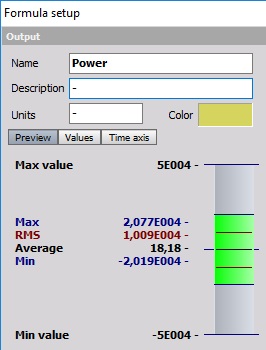
Example - Formula setup window:
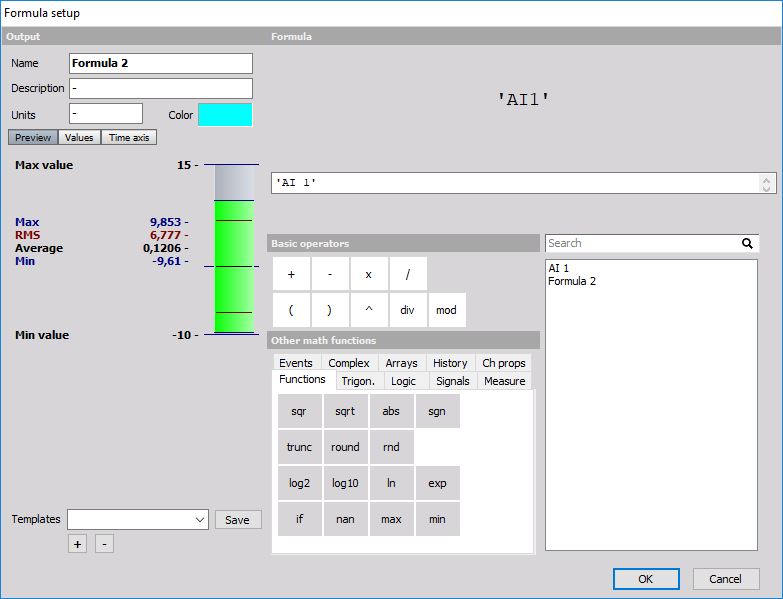
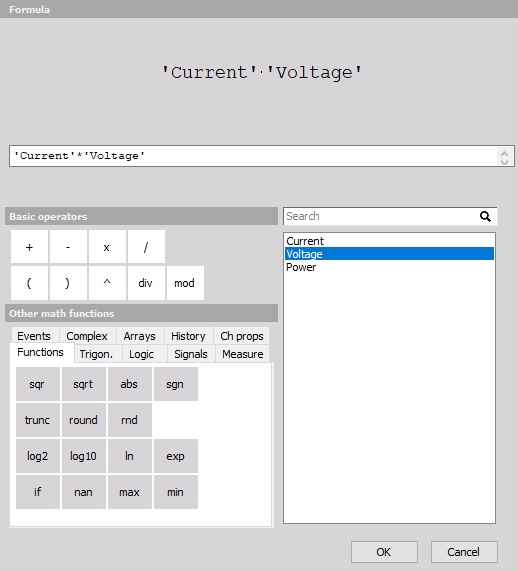
Formula Setup is comprised of two sections:
- Output: General output settings on the top left side of the window.
- Formula: Formula editor on the right side of the window
In Measure Mode
Mathematical functions can be applied to channels during measurement.
Right click the channel on which you want to perform a mathematical operation and select the function from the dropdown menu.
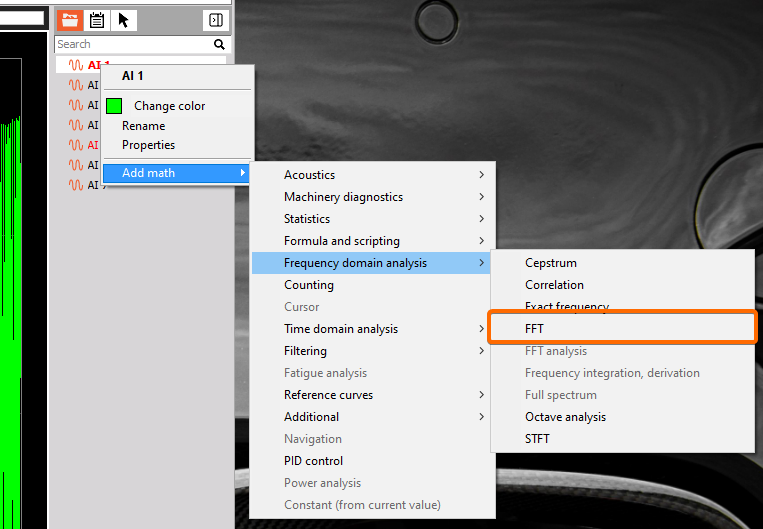
A setup menu will appear: