Discrete Display 
The Discrete Display is designed to show a defined discrete value in order to supervise the values of analog signals in a true / false way.
When selectiong this widget, you will see the following settings in the Widget tab on the left:
You can go to the Example section if you wish to see this widget in use.
Discrete Display and Values
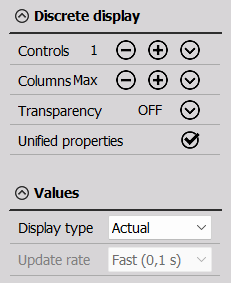
These are control properties and graph settings, identical for all widgets. Please refer to Control Properties and Graph Settings sections of the manual for more information.
Drawing Options
The widget is rectangular, with the assigned channel name and description above the discrete value displayed.
You can use the following options to customize the appearance:
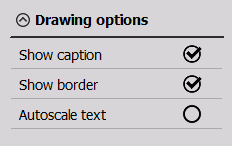
- Show caption - shows the assigned channel name and its description
- Show border - a thin white border around the widget
- Autoscale text - adjusts the size of the text to the size of the widget automatically
Discrete Values
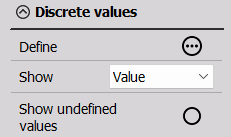
In this field, you will set how the Discrete display will behave and which signal it will monitor. Before changing the discrete values, make sure that you have assigned the correct channel to the widget - please consult Channel Selector for more information if needed. A channel can have a set of predefined values - for example, a binary CAN channel for ABS can have three states with codes 0, 1 and 2 which represent ON, OFF, and ERROR.
Firstly, you will need to Define discrete values. A window will pop up.
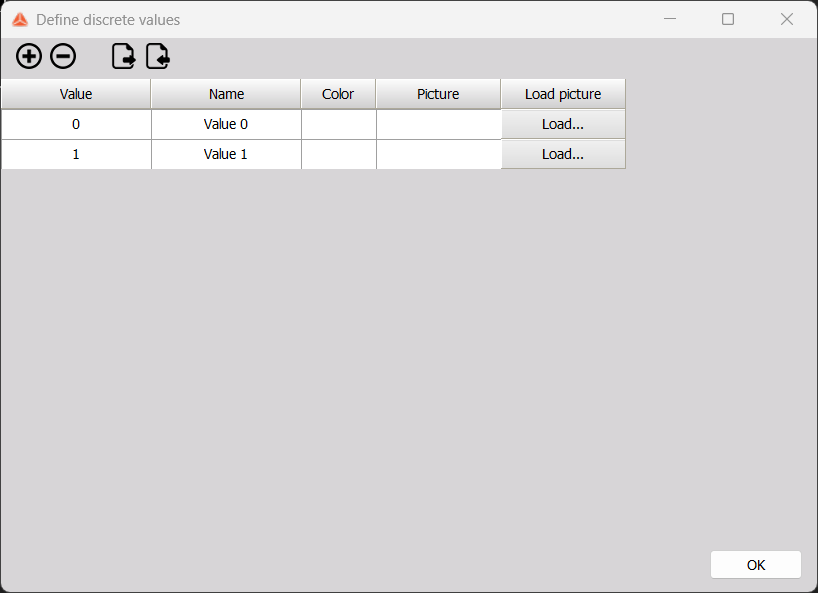
The buttons above the table are, from left to right: Add and Remove buttons, copy the list of values to and from clipboard. If removing a value, make sure to select it by clicking on it first.

The columns in this menu are:
- Value - value of the channel
- Name - will be displayed on the discrete display
- Color - color of Name when displayed
- Picture - the picture you assigned by clicking on Load… in the next column will appear here
- Load picture - upload a .bmp file
By using the dropdown menu Show, you can choose whether you want the value, picture, or both displayed.
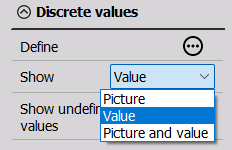
By checking Show undefined values, values not entered in the Define menu will still be shown on the display.
Example
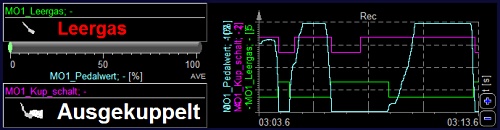
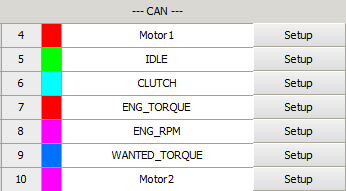
We will use CAN channels which have defined discrete values. There are a few channels which describe the bit value if the car is running in idle (MO1_Leergas) and if the clutch is pressed (MO1_Kup_schalt). The channels have defined discrete values which are loaded from the DBC library.
Now, we will create a display to monitor the position of the clutch and gas pedals. We have also added the bar and recorder to show the values of the status and gas pedal position channels.
Acceleration:
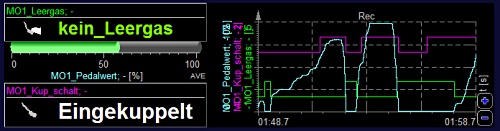
Gear switching: